
To What Extent Is Intelligence the Bottleneck?
Why even an "intelligence explosion" might leave daily life weirdly familiar

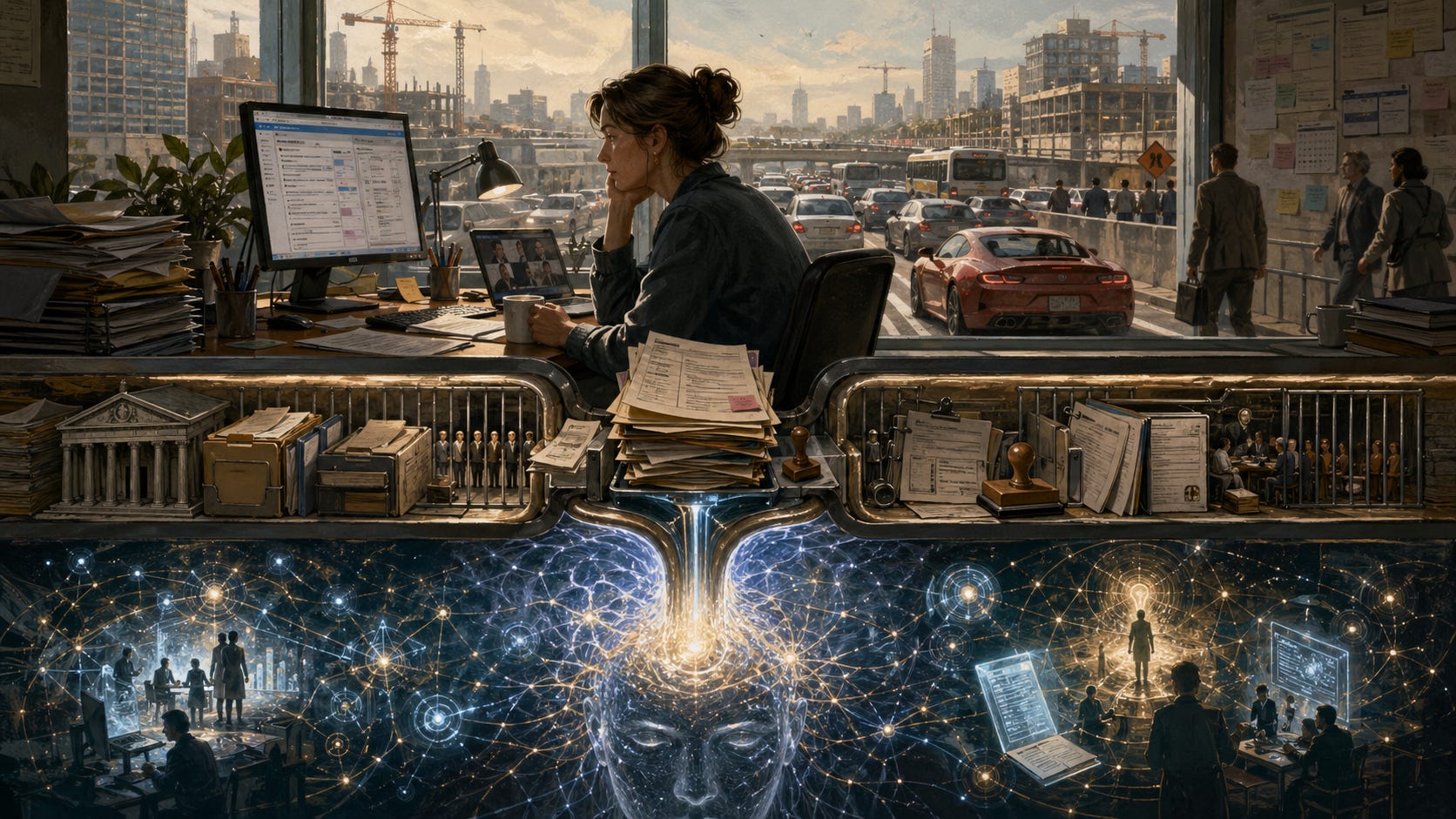
We’ve now built a culture-wide story that goes something like this:
Smarter-than-human AI arrives → everything breaks → society “transitions” (translation: chaos) → we wake up in a world that is unrecognizable.
But what if that core assumption is wrong?
What if intelligence is not actually the bottleneck for most of the things that matter in everyday life and work? What if we get an intelligence explosion… and your Tuesday still involves a queue of messages, annoying forms, pointless meetings, the same three apps stealing your attention, and your back still hurts?
Intelligence is not the same thing as power
First distinction, and it’s an important one: more intelligence is not the same as more impact.
You can have a genius trapped in an institution that ignores them. A brilliant plan with no political path. A perfect design that nobody funds. A solution that’s illegal to deploy.
In every one of those cases, intelligence is present but some other bottleneck is binding. Power. Coordination. Capital. Incentives. Law. Social norms. Inertia.
An intelligence explosion mostly says: you now have access to a ridiculous amount of good thinking. It does not automatically say: the world will obediently rearrange itself according to that thinking.
A lot of our big problems are not IQ-constrained
We already know how to build clean energy. The limiting factors are deployment, politics, supply chains, and land use - not “we need a 200 IQ physicist.” We know how to reduce pandemics, obesity, traffic deaths, and many chronic diseases. The limiting factors are incentives, culture, habits, and governance. We know how to educate children effectively. The bottlenecks are implementation complexity, inequality, and institutional inertia.
An intelligence explosion might give us better plans, better proofs, better simulations. But if the binding constraints are “the zoning board won’t approve it,” “this would hurt a powerful interest group,” “people won’t vote for that,” or “no one wants to take the career risk of trying this” or then higher intelligence sits there like another BMW or Porsche on the 405.
We’ve already absorbed several “intelligence multipliers”
We’ve already had technologies that massively amplified human cognition: writing, the printing press, the internet, search engines, programming, smartphones. Each of those was, in its own way, an intelligence prosthetic - radically cheapening access to knowledge, memory, and reasoning tools.
Did life change? Absolutely. Did it become unrecognizable day-to-day, year-to-year? Not really.
Your grandparents’ life and your life are different, but people still go to jobs. Bureaucracies still exist. Politics is still politics or worse. Most “work” is still coordination, persuasion, and status games. Cycles shortened, possibilities expanded, and yet the pattern of life rhymed with the old one.
Work becomes less about “doing” and more about “being there”
In the “AI eats all the jobs” story, people imagine a clean logic: If an AI can do my work better, why am I still employed?
But look closely at a lot of jobs. A huge amount of modern work is not about solving hard technical problems. It’s about being a specific person in a specific network. Providing emotional reassurance and accountability. Taking responsibility when things go wrong. Being the node someone can blame, trust, or yell at.
Doctors, managers, teachers, consultants, lawyers, therapists, salespeople - even if AI can out-think every one of them, there’s still regulation (you must have a human sign-off), liability (someone has to be on the hook), and trust (people want a who, not just a what).
In that world, AI’s role becomes: hyper-competent background intelligence that makes the human look very prepared.
Your day-to-day workflow might feel like this: you show up. Your AI assistants have done 95% of the prep, drafting, analysis, and simulation. You spend your time choosing, editing, vetoing, and communicating. Is that a big change? Yes. Is it “no more jobs”? Not necessarily. It’s closer to your job turning into curation, arbitration, and human presence instead of raw problem-solving. The intelligence explosion happens in the engine room. Your job title still says “Product Manager.”
The physical world changes slowly
Even if superintelligent AI designs perfect buildings, perfect transit networks, perfect factories, and perfect cities - we still have existing infrastructure, construction timelines, safety standards, and long replacement cycles.
Bridges aren’t patched with over-the-air updates. Your commute doesn’t vanish just because an AI found a better city layout.
At best, you get incrementally better routing and logistics, better maintenance scheduling, and better urban planning for future builds. The intelligence explosion might be visible as “huh, shipping is weirdly cheap now” or “things seem to break less” or “the new buildings are way better designed.” But day-to-day? Still groceries, commutes, physical reality dragging its feet behind the evolving digital genius.
The most powerful mind in history, constrained by concrete cure times and permit applications.
Institutions absorb arbitrarily large amounts of competence
Here’s a thought experiment. Imagine giving a hyper-rational, hyper-capable planning system to a large bureaucracy.
Does the bureaucracy: (a) transform into a sleek, ruthlessly efficient machine, or (b) use the AI to generate better slide decks justifying what it was going to do anyway?
Option (b) is depressingly plausible. And if you’ve spent any time inside a large organization, you already know why.
Institutions can use superintelligence to better defend their own existence, generate more sophisticated excuses, and optimize for their current incentives faster - not necessarily for global welfare. Intelligence explosions amplify whatever is already there. A great institution becomes terrifyingly effective at doing good. A dysfunctional one becomes terrifyingly effective at staying dysfunctional.
I do wonder: Will AI-first organizations seed and grow to outcompete the human-decision-tree-first organizations? Subject for another time.
From the standpoint of your average citizen or employee, life might feel like: the bureaucracy got weirder, the forms got auto-filled, the decisions got harder to challenge, and nobody seems to fully understand how anything works but did they really before?
That’s a big deal at the civilizational level. But it’s not the clean sci-fi narrative of “old world / new world.”
Attention, not intelligence, becomes the scarce resource
Right now, intelligence is expensive and human attention is relatively cheap. In an intelligence explosion, that equation flips. Cognitive labor becomes nearly free. Insights, drafts, plans - unlimited.
But human attention, human trust, human emotional bandwidth - those stay finite. And no one is having babies.
The result? The value of your attention goes up. The competition to capture that attention gets more intense. And the premium on trusted humans - friends, guides, curators, filters - rises with it.
So what does change?
If intelligence isn’t the main bottleneck, what does an explosion of it actually do?
Some plausible shifts: Research and engineering get orders-of-magnitude faster cycles - new drugs, materials, algorithms, and designs discovered and validated in simulation before anyone touches a lab bench. Optimization quietly improves everything - logistics, energy use, workflows, scheduling - producing subtle gains that add up but don’t feel like magic from the outside. Prices decline in surprising ways as capitalism adjusts to production unconstrained by human labor. New kinds of art and media emerge - personalized, adaptive, practically infinite - your entertainment tailored in real time by models that know you better than you know yourself. And governance faces mounting pressure as policymaking and law struggle to keep pace with a world where capability is outrunning procedure.
Those are big deals. They might slowly reshape the curve of history.
But your lived experience could still be: wake up, check messages, interact with a mix of humans and assistants, do some kind of work that’s mostly about choices and relationships and responsibility, consume a lot of information, and try to make sense of life in a world that’s changing - but not as fast or as for the better as the hype promised.
So a civilization with godlike tools will still feel like a civilization of barely capable and mostly hairless primates trying to schedule meetings.
If intelligence is not the bottleneck, what is?
If this framing is roughly right, the crucial constraints are things like:
Coordination - can we actually act on good plans together? Incentives - do people get rewarded for long-term, systemic improvements, or for short-term wins? Power - who controls the systems that deploy the intelligence? Values - what do we aim the intelligence at? Legibility - do humans understand enough to push back or guide? Psychology - can individuals and societies emotionally cope with rapid capability growth?
Those are messy bottlenecks. You don’t break them with IQ.
The real uncaging
The phrase “intelligence explosion” tempts us into a particular mental model: once we have enough intelligence, the cage of limitation bursts open by itself.
So here’s the unsettling place I might land for now: we might live through an intelligence explosion and discover that the hardest problems were never purely about thinking better. They were about wanting better, choosing better, and acting together.
Ugh. I would say god help us but we already have what we need.
Interesting - totally agree with this take… I was watching a show set in the 60’s and thinking about daily life and how it was not much different than today. Tv screens, refrigerators and washing machines all part of life - and the pattern of the day is very similar… of course not exactly. We still wake up, get ready, eat what is considered healthy or tasty now, try to do something we deem productive that produces income, spend time with family and friends in a meaningful way and go to bed. Our thinking is influenced in reaction to media in some form. We carry on.
That just gets me thinking. What is really beyond it all then? What is it for? Can I tap into a space of infinite truth, awareness and bliss.